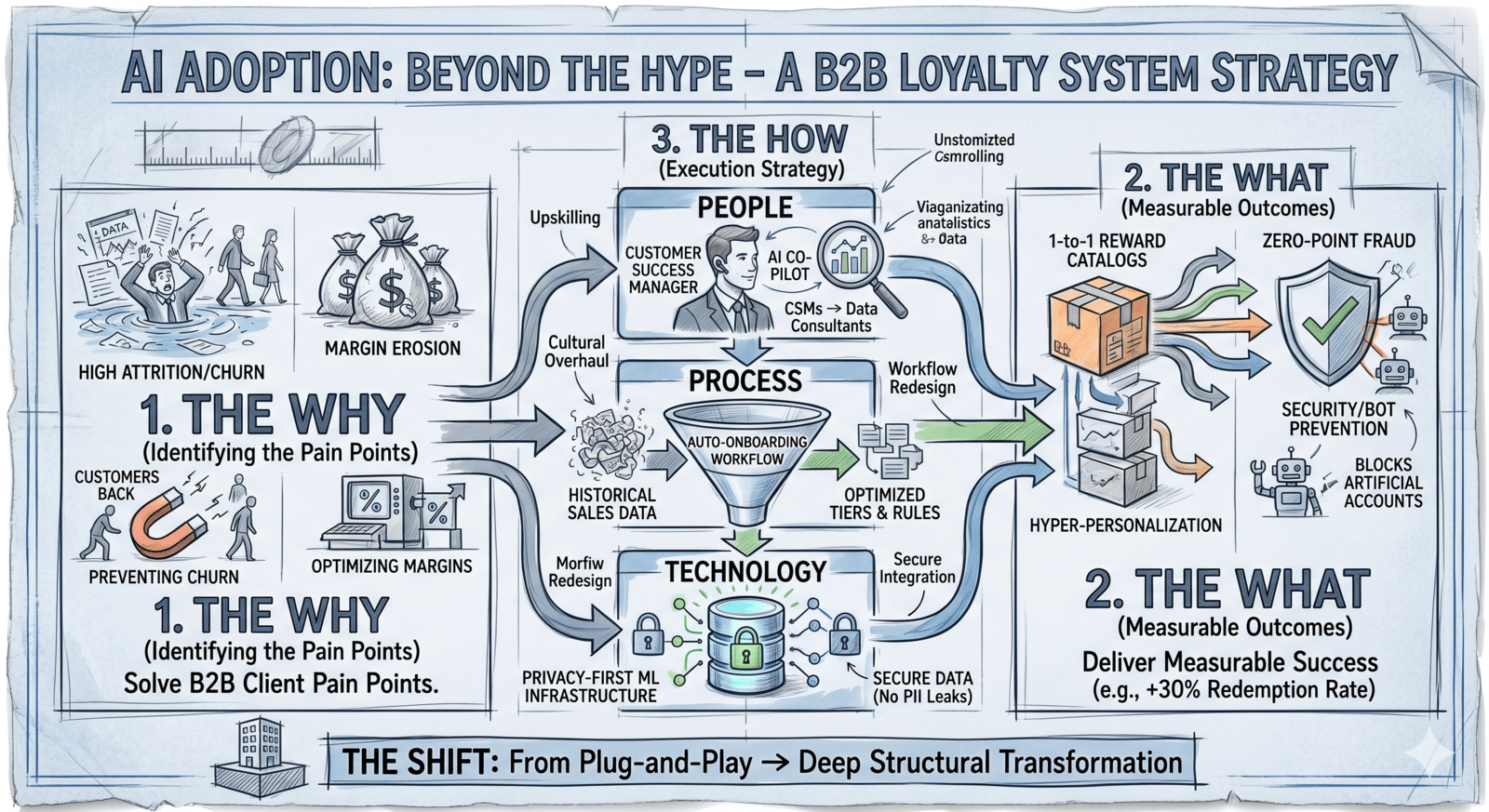
Right now, every organization claims it is “fully using AI.” But when we look closer, the reality often falls short. True AI adoption isn’t just a trend or a badge of honor; it represents a major change. To go deeper, we need to stop viewing AI as a quick fix and start seeing it as a strategic shift. This involves tackling three important questions: The Why, The What, and The How.
The WHY: Identifying the Strategic Driver.
Adopting AI simply because your competitors are doing it leads to wasted money. We need to pinpoint the specific business issue we want to address.
For example, in churning prevention, the loyalty provider doesn’t just use AI; we use it to solve the high cost of customer attrition for our retail clients. By deploying predictive AI, we analyze shopping patterns to identify which end-consumers are about to churn before they leave, allowing the brand to intervene.
The WHAT: Defining the Ultimate Goal.
The “Why” explains our motivation, while the “What” describes our destination. What does success look like in measurable terms?
For example, personalization: The “What” is moving away from generic tier systems (Gold/Silver/Bronze). The ultimate goal: An AI engine that generates unique, 1-to-1 reward catalogs for each user, aiming to increase point redemption rates by 30% without devaluing the currency.
The HOW: Empowering the Three Pillars.
This is where many companies struggle. AI isn’t just a technology stack; it requires a change in culture and operations involving People, Process, and Technology.
First Pillar: People.
It’s not about replacing workers; it’s about empowering them.
Example: The loyalty company trains its Customer Success Managers (CSMs) to become “Data Consultants.” Instead of just showing merchants how to use the software, CSMs use AI-generated insights to proactively advise brands on how to tweak their reward campaigns for maximum ROI.
Second Pillar: Process
We can’t insert new AI into outdated workflows. We need to update it.
Example: We redesigned our entire client onboarding process. Instead of asking a new retail client to manually guess and configure their reward tiers, the AI ingests the retailer’s historical sales data and automatically structures the optimal loyalty tiers, points values, and rules on day one.
Third Pillar: Technology
Selecting the right tool for the right environment.
Example: Because a loyalty system handles massive amounts of consumer purchase data, we invest in secure, privacy-first machine learning architectures.
The Bottom Line
AI adoption isn’t a sprint; it’s a significant renovation. The effectiveness of our AI usage isn’t determined by how complex the code is but by how clear our goals are. If we haven’t aligned our People, Processes, and Technology with a clear Why and What, we aren’t truly adopting AI—we are just riding the wave of the hype.
Madinah, 12 May 2026 (25 Dzulqa’dah 1447)