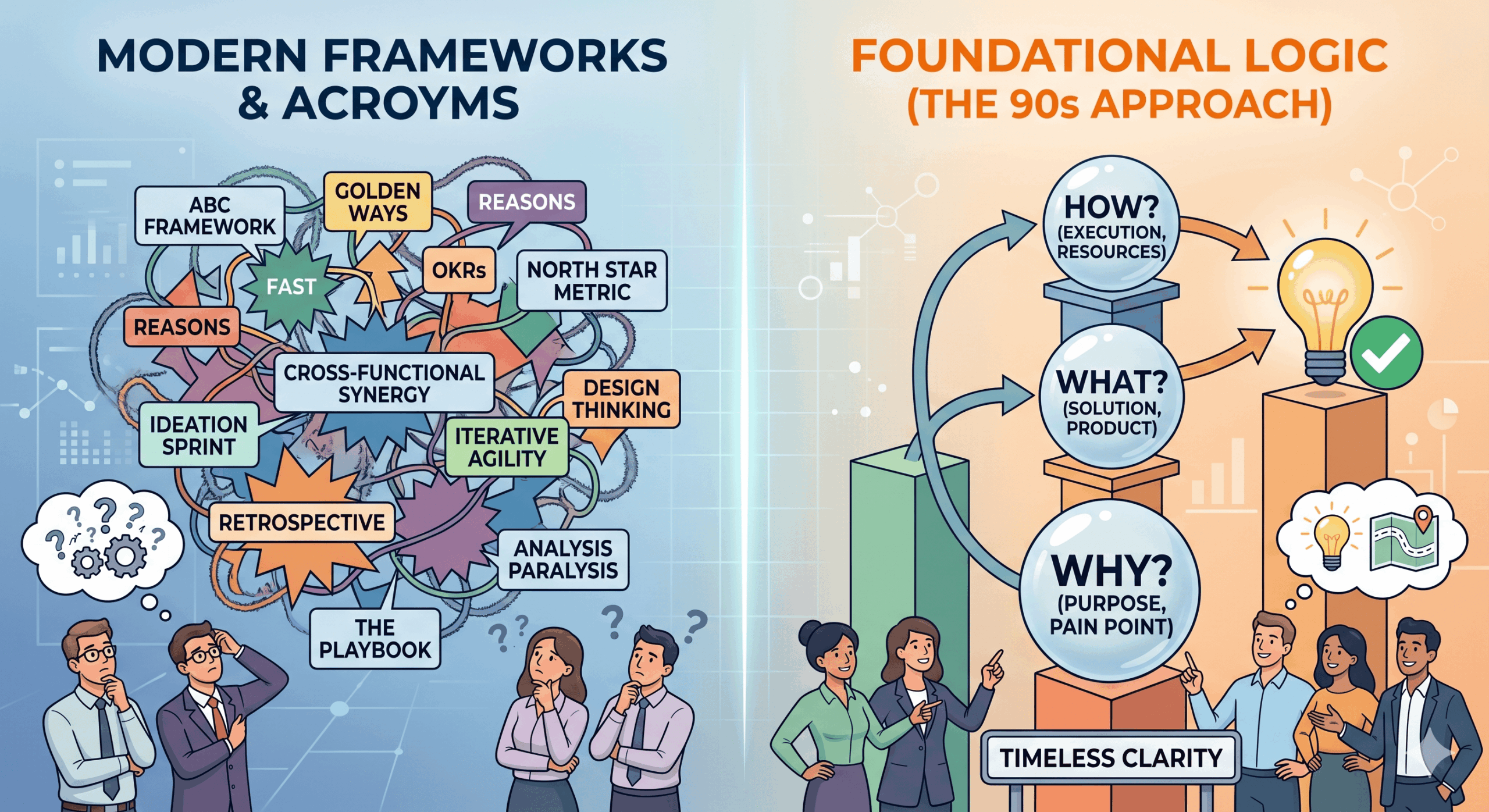
The modern business world is filled with proprietary acronyms and branded frameworks like ABC, Golden Ways, or FAST, or North Star Metric. These terms often disguise old ideas as new and sophisticated. While they are promoted as innovative breakthroughs in strategic thinking, they usually just repackage foundational logic from decades ago.
By using complicated jargon to present simple concepts, organizations may unintentionally create barriers, making straightforward processes seem more exclusive and complicated than they really are.
In the 90s and 2000s, evaluating any new venture or project boiled down to three key, simple, and straightforward questions: Why, What, and How.
“Why” identifies the purpose and the problem being addressed.
“What” specifies the actual product or solution.
“How” explains the execution and resource allocation.
This approach offered a clear view of a business goal without needing a lengthy glossary. It demanded clarity and focused on basic problem-solving principles rather than presentation style.
The trend toward fancy terminology often arises from a psychological bias that confuses complexity with expertise. When a person presents a “Multidimensional Synergy Alignment Strategy” rather than simply discussing “teamwork,” it creates the impression of high-level knowledge.
However, this can result in analysis paralysis, where teams spend more time learning a framework’s vocabulary than doing the work.
In the end, whether you call it a “North Star Metric” or a “Primary Goal,” the aim is the same: to understand where we are headed and how we plan to reach that destination.
Madinah, 14 May 2026, (27 Dzulqa’dah 1447)