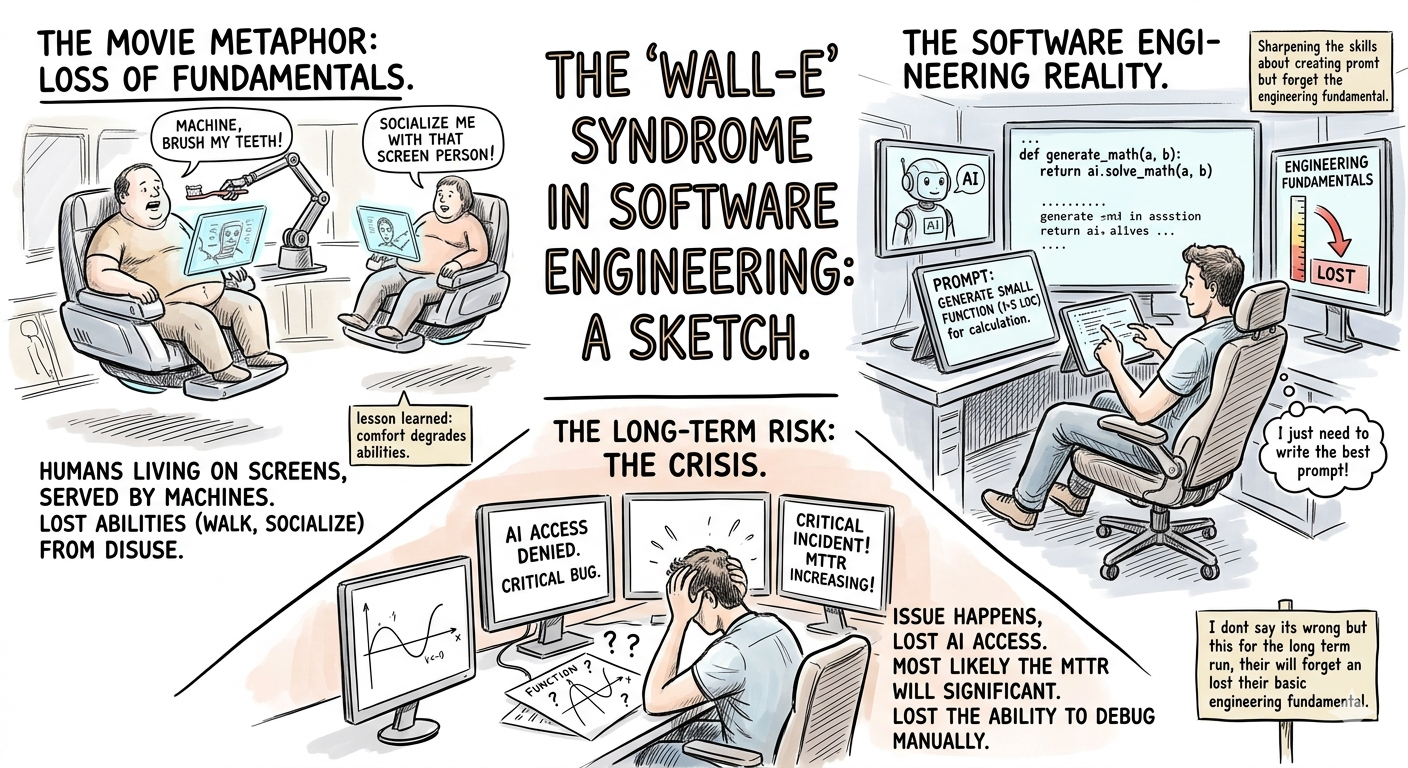
In the movie Wall-E, humans lose their ability to walk because machines have catered to their every need—down to brushing their teeth. Worse still, despite living together on the same spaceship, they rarely interact with one another. The underlying lesson is clear: when we become too comfortable relying on machines, we risk losing our most fundamental abilities due to a lack of practice.
I am beginning to observe a similar phenomenon in software engineering, as developers increasingly delegate their daily work to AI. Many are heavily honing their prompt engineering skills at the expense of core software fundamentals. I recently watched an engineer write a two-line prompt just to generate a basic 1-5 line function, rather than simply coding it themselves.
While leveraging AI isn’t inherently wrong, this over-reliance poses a serious long-term risk. If these engineers ever face a critical system issue without access to their AI tools, the Mean Time To Recovery (MTTR) will likely skyrocket, as they will have lost the critical muscle memory required to manually debug and resolve complex problems.
AI era comes with a costs. And we should prepare for all the costs we need to pay.
Madinah, April 2026 (Dzulqa’dah, 1447)